
artificial intelligence assistants
smart monitoring and productivity enhancement systems

Modern Automation Technologies
Modern automation technologies that fully meet your needs: In the modern industrial world, the need for modernization and automation of production processes is becoming increasingly urgent. Our company provides a set of solutions that include the following:
Artificial Intelligence Assistants
MKIA (Maintenance Knowledge Industrial Agent)
– MKIA (Maintenance Knowledge Industrial Agent):
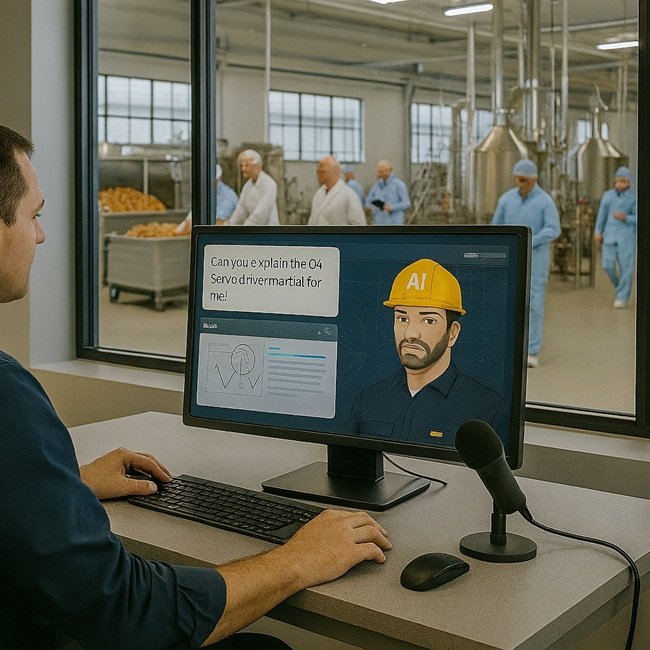
AI without real time connection (digitalization) of production machines network. Our company creates an artificial intelligence employee, specialized to reactivate the technical department of any type of industry. This employee, as an assistant to the technical director or technical chief, is the 24/7 digital partner of the technical department.Filonas company innovation in this case is due to the fact that it does not need to be preceded by digitalization of the entire industrial unit. Digitalization is not intended for low and medium-sized industries due to the high cost.On the contrary, this particular artificial intelligence assistant is accessible to all types and sizes of industries.This is the most economical solution for investing in artificial intelligence, focusing on improving productivity, minimizing production line downtime, quickly resolving faults and easing office work.
OTIA (Operational Technology Industrial Agent)
– OTIA (Operational Technology Industrial Agent):
AI with real time connection (digitization) of production machines network. Artificial intelligence (AI) is the catalyst that transforms a digitized factory into a truly intelligent production system.While digitalization provides the data and connectivity needed to collect and transfer information, artificial intelligence is what gives meaning to that data, makes decisions, and optimizes processes in real time.In a digitalized factory, artificial intelligence can be integrated into multiple levels of the production process. Initially, AI systems receive a huge amount of data from sensors, machines and recording systems, which is collected and stored in cloud or edge computing infrastructures.Machine learning algorithms then analyze this data, identify patterns, predict problems, and recommend optimal solutions.
Advantages of Artificial Intelligence in Factory 4.0
- Performance increase:By continuously optimizing production, factories can achieve increased productivity at optimal prices.
- Operation cost reduction: Preventive maintenance, waste reduction and more efficient quality control drastically reduce operating costs.
- High quality of products: The accuracy and consistency provided by AI nearly eliminates defects, leading to higher customer satisfaction and fewer returns.
- Competitive advantage: Companies that adopt AI can adapt quickly to market changes and better cope with competitive challenges.
- Low risk data: AI can test ideas and strategies in digital simulations before implementing them in real production, avoiding misguided testing.
- Improving employee safety: AI analyzes and identifies potential accident-causing points.
autonomous monitoring systems
Our company installs all kinds of sensors and manufactures small automations for targeted intervention for every need. We provide comprehensive solutions for measuring the efficiency of production lines Overall Equipment Effectiveness (ΟΕΕ). In the context of the development and design of automations, we use branded electronic equipment from various companies. For flexibility in cost, our company provides its own calculation system ΟΕΕ (OPTILINE), with real-time efficiency analysis and the ability to expand accuracy by placing sensors at multiple points of interest.
-Benefits of autonomous equipment and machinery monitoring systems:
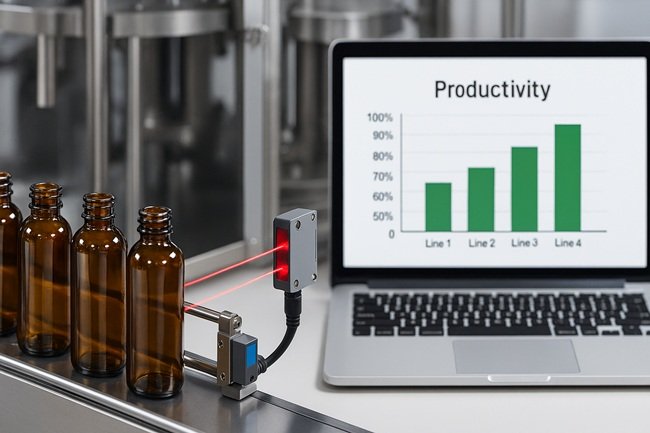
- Counting Products: High-precision photocells and sensors monitor every product that passes through the production line, creating accurate production statistics in real time. You know exactly what is being produced and how much.
- Raw Material Monitoring: Weighing systems and sensors track the quantities, types and quality of raw materials entering the process. This ensures consistency in the composition and quality of the final product.
- Classification and Categorization: Identification systems can classify products by category, size or quality.
- Monitoring Critical Conditions: Temperature, humidity, pressure, air quality sensors, etc.
- Vibration – Noise Level Monitoring: Vibration sensors detect abnormal vibrations that could indicate equipment wear or alignment problems, allowing for damage prevention.
- Equipment Temperature Monitoring: Thermal cameras and sensors monitor the temperature of critical components, warning of overheating problems.
- Energy Consumption Monitoring: Energy analyzers compute the energy footprint, creating the basis for relevant decision-making and financial management.
- Personnel Presence Motion Detection: Motion sensors detect the presence of people in specific zones. Ensures that personnel do not enter dangerous areas. Provides voice warnings and advice about the surrounding area. Remote reporting and recording. Provides critical information in the event of an accident.
- Video Surveillance Systems: High-resolution cameras with AI capabilities monitor the space in real time, identifying unauthorized access, dangerous behavior or abnormal activities.
READ MORE
Efficiency Measurement: Overall Equipment Effectiveness (OEE)
One of the most important indicators of a plant’s success is Overall Equipment Effectiveness (OEE). This critical indicator measures how efficiently equipment is operating compared to its ideal capacity. OEE is calculated from three key parameters:
Availability: The percentage of time that equipment is available for operation, not down or under maintenance. If equipment is frequently down due to malfunctions or breakdowns, availability is reduced.
Performance: The speed at which the equipment operates relative to its maximum theoretical speed. If the equipment is not operating at its rated speed, or if there are delays in the process, efficiency is reduced.
Quality: The percentage of products produced in good condition, without defects or problems. If the equipment produces a high percentage of defective products, quality is reduced.
Calculation: ΟΕΕ = Availability× Performance × Quality
For example, if availability is 90%, efficiency is 95%, and quality is 98%, then the OEE is: 0.90 × 0.95 × 0.98 = 83.79%. A high OEE (ideally above 85%) indicates that the equipment is working close to its limits and that production is efficient and reliable. A low value of the OEE index indicates that there are problems that reduce productivity and increase costs.
Smart monitoring systems play a critical role in improving the OEE:
- Increase Availability:: Preventive monitoring detects problems before they cause damage, reducing downtime and ensuring that equipment is always ready to operate.
- Increase Performance: Detection of delays and anomalies in the process provides real-time feedback, allowing optimization of speed and efficiency.
- Increase Quality: Quality control systems prevent the production of defective products and ensure consistency in the final product.
Energy management
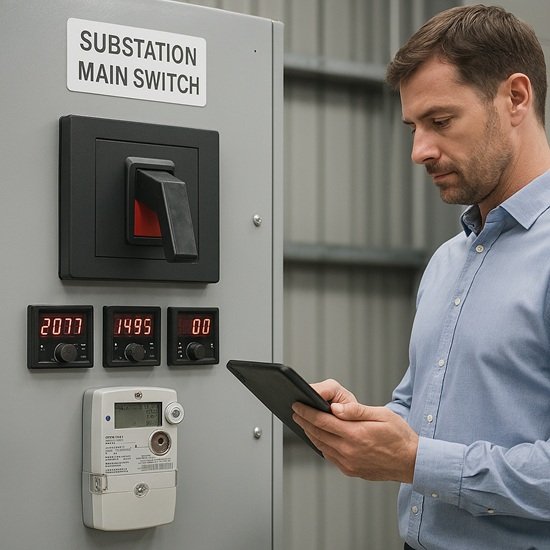
Energy Management of Modern Industry – Benefits: One of the necessary steps for the energy management of a production unit is to record energy consumption by placing appropriate measuring devices in appropriate and useful points of the equipment. Additionally, it is the first and necessary step for the implementation of an ISO 50001 energy management system. Common provisions used are:
- Smart energy meters
- Steam flow meters
- Natural gas meters
- Water flow meters
- Temperature meters
With the implementation and operation of the energy management system, the following will be possible:
- The identification of high energy consumption points with the aim of corrective interventions and savings proposals.
- The reliable planning and monitoring of each energy saving measure that will be implemented in the future as there will be a history before and after its implementation.
- The planning of production and operation of machinery based on the conclusions that will emerge from individual energy consumption.
- Costing based on energy consumed per product.
- The creation of an energy management system in the company.